Stevia Packaging Sizes & Dimensions: A Complete Guide
Table of contents
- Why size matters for stevia packaging
- Standard stevia packaging size chart
- How to measure for stevia packaging
- A worked example
- Choosing a size by portion and quantity
- Board thickness by size
- Inserts, dividers and fit
- Stacking, storage and delivery
- Sizes for different service styles
- Matching sizes across your packaging range
- How size affects cost
- Custom sizes vs stock sizes
- Size checklist before you order
- Common sizing mistakes
- In summary
Choosing the right size is the most important decision you'll make when ordering custom stevia packaging. Get it right and your stevia packets and jars arrive looking exactly as they left the kitchen. Get it wrong and you pay for wasted board, crushed food or boxes that won't close.
This guide covers the standard sizes for stevia packaging, how to measure your food, how portion sizes map to box dimensions, and the mistakes we see most often when brands order for the first time.
Why size matters for stevia packaging
A box that's too large lets stevia packets and jars slide, tip and lose their presentation. It also uses more board, takes up more space in storage and costs more to ship. A box that's too small squashes toppings, crushes edges and may not close, which is a food-safety and customer-experience problem.
The right size is snug but not tight. For most stevia packaging, that means a few millimeters of clearance around the food, extra headroom for toppings or icing, and room for any liner, insert or sauce cup you plan to include.
Standard stevia packaging size chart
These are the sizes we're asked for most often. Dimensions are listed as length x width x height in inches unless noted.
| Size | Dimensions | Best for |
|---|---|---|
| 50 packets | 3.5 x 2.5 x 3 in | single-serve packets |
| 100 packets | 4.5 x 3 x 3.5 in | cafe box |
| Dropper bottle box | 1.5 x 1.5 x 4.5 in | liquid stevia |
| Jar box | 3 x 3 x 4 in | powder jar |
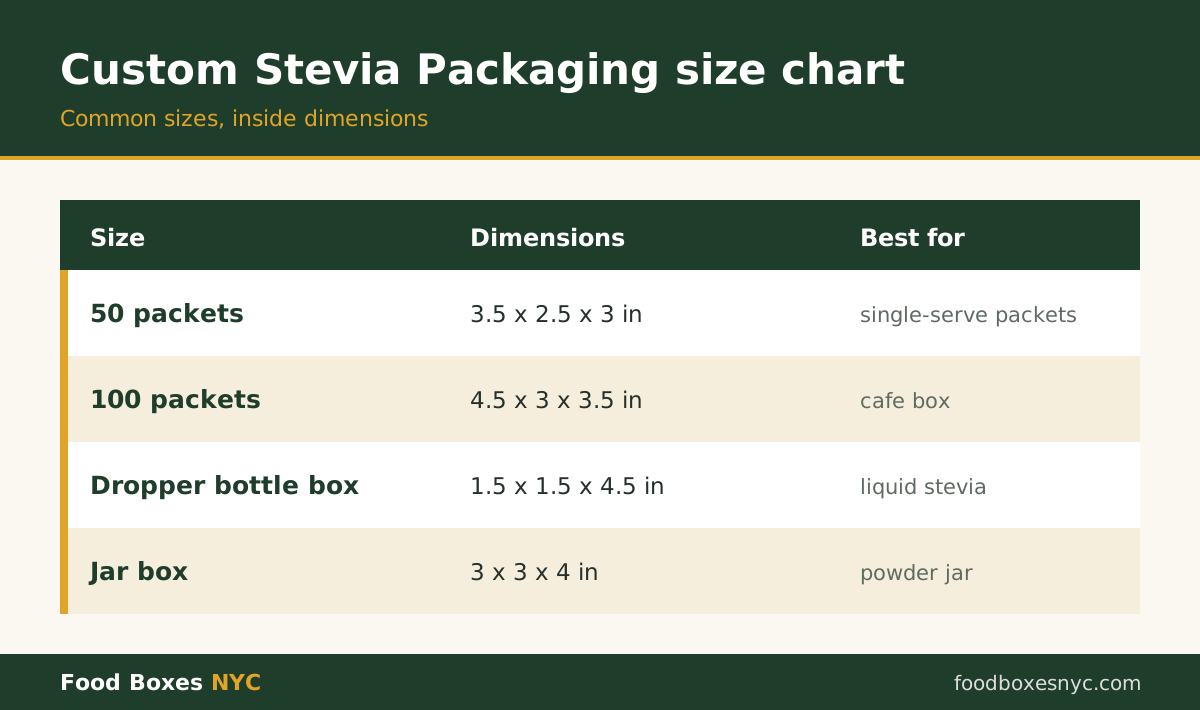
Treat these as starting points. Your recipe, portion size and serving style may call for slightly different dimensions, and every order can be made to your exact measurements.
How to measure for stevia packaging
- Measure the food as served. Plate or pack a typical portion the way customers receive it, including toppings, garnish and wrapping.
- Record length, width and height. Measure the longest side first, then the shorter side, then the tallest point.
- Add clearance. Allow roughly 1/8 to 1/4 in on each side for easy loading, and more headroom for soft toppings, icing or steam.
- Account for extras. Add space for liners, inserts, dividers, sauce cups, napkins or utensils.
- Use one unit. Stick to inches or millimeters throughout so nothing gets lost in conversion.
We quote by inside dimensions, the usable space for your food. Board thickness adds a little to the outside, which matters if the box needs to fit a bag, shelf, display case or delivery insulated carrier.
A worked example
Say a customer orders a regular portion of stevia packets and jars. You pack it as served and measure the food at roughly 4.5 across. Add clearance on each side for easy loading, a little extra height for toppings or steam, and allow for a liner if you use one. That brings you to the 100 packets size in the chart, 4.5 x 3 x 3.5 in.
Now check the box in your real workflow: does it fit the bag you use, does it stack on the pass, and does the lid close without touching the food? If the answer to all three is yes, you've found your size. If not, adjust by 1/4 in at a time, or ask us for a plain sample to test before printing your stevia packaging.
Choosing a size by portion and quantity
Start with how you sell. If you sell single servings, the 50 packets size (3.5 x 2.5 x 3 in) is a common starting point. For regular orders, many brands choose the 100 packets (4.5 x 3 x 3.5 in). Sharing, family and catering orders usually move up to the dropper bottle box (1.5 x 1.5 x 4.5 in) or jar box (3 x 3 x 4 in).
A tiered range also makes upselling easy: customers see the next size up and understand the value immediately.
Board thickness by size
- Small portions: lighter paperboard is usually enough and keeps costs low.
- Medium portions: a mid-weight board holds its shape with hot or saucy food.
- Large and family sizes: heavier board or E-flute corrugated prevents sagging and crushing.
- Delivery and shipping: corrugated or double-wall construction protects food in bags and vehicles.
For stevia packaging, we usually pair the size with dispenser cut-outs so the box stays firm through service.
Inserts, dividers and fit
Inserts keep stevia packets and jars in place and can make one outer box work for several products. Cavity inserts, dividers and trays separate items, stop them sliding and protect delicate edges. If you add an insert, measure the food in the insert and size the box around both.
Liners and wraps also add thickness. A sheet of greaseproof or wax paper is thin, but a corrugated pad or molded tray can add several millimeters.
Stacking, storage and delivery
Think beyond the counter. Boxes that stack neatly save space on prep lines and in delivery bags. Flat-packed boxes take far less storage than pre-assembled ones, and standard footprints fit common carriers and shelves.
If your food travels with third-party delivery apps, test the box in a real delivery bag. A slightly lower height often stops boxes tipping, and vents or handles can make a big difference to how the food arrives.
Sizes for different service styles
- Dine-in and counter service: compact sizes that fit trays and keep presentation tidy.
- Takeout: a little extra headroom for toppings and easy carrying, with secure closures.
- Delivery apps: low, stable footprints that sit flat in insulated bags and resist tipping.
- Retail shelves: sizes that fit standard shelf depths and show the front panel clearly.
- Catering and events: larger family or platter sizes that stack without crushing.
Many brands use one size of stevia packaging for dine-in and a slightly larger one for delivery, where food needs a bit more protection and room for sauces.
Matching sizes across your packaging range
Your stevia packaging rarely travel alone. Think about the bags, trays, cups and wraps that go with them. Choosing sizes that nest or sit side by side in your standard bag makes packing faster and keeps orders neat.
If you sell combos, measure the full set. A burger box, fry container and drink should fit comfortably in one carrier, and a pastry box should fit beside a coffee in a standard cup holder bag.
How size affects cost
Board is priced by area, so every extra inch on stevia packaging adds cost across thousands of units. Oversized boxes also need bigger cartons for storage and shipping, and they take up more space in your kitchen.
On the other hand, a box that's too tight can mean remakes, refunds and poor reviews. The goal is the smallest size that protects stevia packets and jars and presents them well. Consolidating to fewer sizes also lowers cost, because larger runs of each size reduce the unit price.
Custom sizes vs stock sizes
Stock sizes are fast, but they rarely fit perfectly. Custom stevia packaging are built to your portions, so you pay for exactly the board you need and your food looks better on arrival. Because our minimums start at 100 units, custom sizing is practical even for small restaurants and new products.
If you're between sizes, send us your measurements and a photo of the food. We'll recommend dimensions and, where helpful, send a plain sample to test before printing.
Size checklist before you order
- Have you measured a real portion of stevia packets and jars, fully assembled?
- Did you add clearance and headroom?
- Have you allowed for liners, inserts and sauce cups?
- Does the box fit your bags, shelves or display case?
- Have you limited your range to the sizes you really need?
- Would a sample help confirm the fit?
Common sizing mistakes
- Measuring the food without toppings, garnish or packaging layers.
- Forgetting space for sauce cups, utensils or napkins.
- Choosing a box that fits the food but not your delivery bags.
- Ordering too many sizes and splitting quantities too thin.
- Skipping a sample when the fit is critical.
In summary
The best size for stevia packaging is the one that fits your portion snugly, leaves room for extras, and works with how you store and deliver food. Start with the chart above, measure your real portions, and ask for a sample if you're unsure.
Ready to order? Request a free quote with your dimensions and we'll reply within one business day.
Order custom stevia packaging
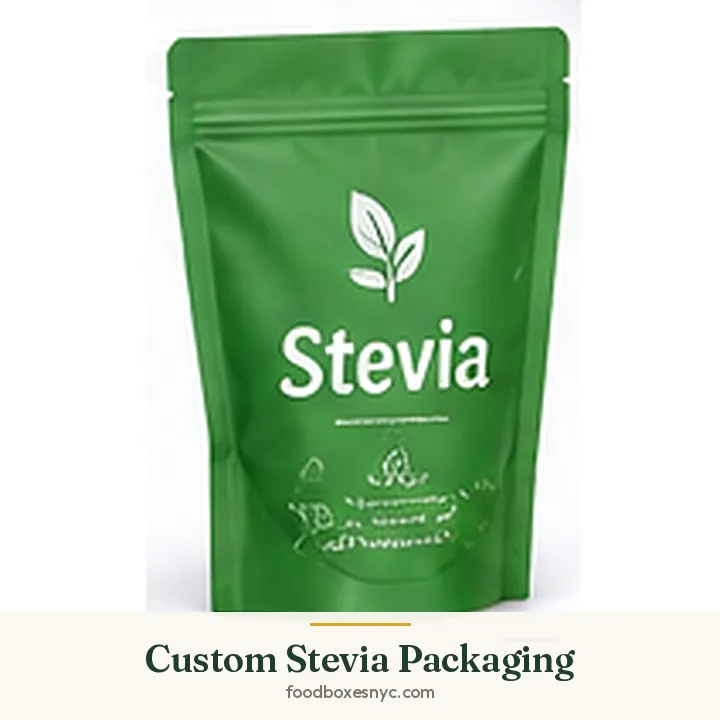
Custom Stevia Packaging for stevia packets and jars, printed with your logo and built with dispenser cut-outs and tuck-end boxes. Low 100-unit.
View product & get a quoteFrequently asked questions
Q: What is the most popular size for stevia packaging?
A: The 100 packets size, 4.5 x 3 x 3.5 in, is one of the most requested, but the right size depends on your portions.
Q: Can I order stevia packaging in a custom size?
A: Yes. Every order is made to your dimensions, from 100 units.
Q: Do you quote inside or outside dimensions?
A: We quote inside dimensions, the usable space for food. Tell us if the outside must fit a bag or shelf.
Q: Can I get a sample before ordering?
A: Yes. We can send a plain sample to check the fit before printing.
Q: How much do custom stevia packaging cost?
A: Price depends on size, quantity, material, printing and finishes. Larger runs lower the unit price, and simple one- or two-color printing on kraft is often the most economical. Send your specs through the quote form and we'll reply with tiered pricing within one business day.

Food Boxes NYC team
Our packaging specialists help restaurants, bakeries, food trucks and food brands choose sizes, materials, coatings and designs. Every guide draws on the questions customers ask us while planning real orders.